Posts

Showing posts with the label tests

Suggestions on rationalising curriculum

Inviting suggestions on rationalising curriculum/ syllabus/ subject contents for class I to class XII with the objective of all round development of students "It has been envisioned that in order to develop a fairer and more egalitarian society comprising of well-balanced human beings, in addition to cognitive and analytical skills,adequate attention on activities like life skills, experiential learning,health and physical education, sports, visual and performing arts,literary & creative skills, and work based education are indispensable. Though the existing curriculum does incorporate these skills, however, the load of curriculum in cognitive and analytical area seems to be so heavy that students practically do not get much time to develop skills in other areas. In order to balance the curriculum for cognitive and analytical areas with curriculum in other life skills including creativity and sports, specific suggestions are invited from teachers, academics, students, parents ...

Suggestions on rationalising curriculum

Inviting suggestions on rationalising curriculum/ syllabus/ subject contents for class I to class XII with the objective of all round development of students "It has been envisioned that in order to develop a fairer and more egalitarian society comprising of well-balanced human beings, in addition to cognitive and analytical skills,adequate attention on activities like life skills, experiential learning,health and physical education, sports, visual and performing arts,literary & creative skills, and work based education are indispensable. Though the existing curriculum does incorporate these skills, however, the load of curriculum in cognitive and analytical area seems to be so heavy that students practically do not get much time to develop skills in other areas. In order to balance the curriculum for cognitive and analytical areas with curriculum in other life skills including creativity and sports, specific suggestions are invited from teachers, academics, students, pare...

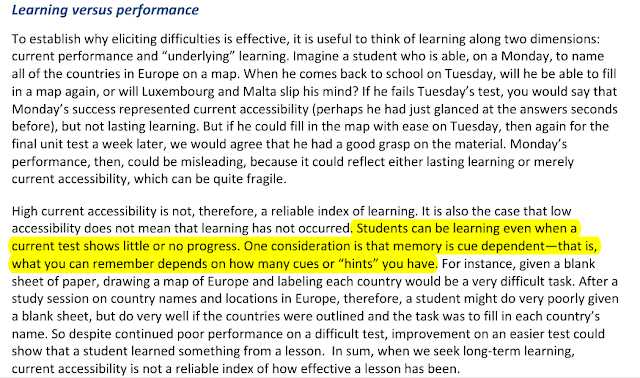
Question designing should be brain-friendly cue based

Image
Why question designing should be brain-friendly and cue based? Evidence: Applying Science of Learning in Education (Society for the Teaching of Psychology) We make up stories, Memory is reconstructive not reproductive Reconstructive memory refers to the way memories are pieced together from bits of information. Memories are not perfectly formed, and they depend on outside influences to develop the whole picture. These influences can be anything, such as a person's own expectations or suggestions from other people. People want to believe that memories are perfect and not able to be molded by information outside of the memory. However, in memory recall, there are blind spots. The brain fills in those gaps, and that is reconstructive memory. When recollecting a memory, a person will remember pieces of it and, in order to form a whole memory, they add to it, or reconstruct it. Reference Video [embed]https://youtu.be/EIH9UBkEJJA[/embed] https://www.ibiology.org/neuroscience/what-we-thi...

Question designing should be brain-friendly cue based

Image
Why question designing should be brain-friendly and cue based? Evidence: Applying Science of Learning in Education (Society for the Teaching of Psychology) We make up stories, Memory is reconstructive not reproductive Reconstructive memory refers to the way memories are pieced together from bits of information. Memories are not perfectly formed, and they depend on outside influences to develop the whole picture. These influences can be anything, such as a person's own expectations or suggestions from other people. People want to believe that memories are perfect and not able to be molded by information outside of the memory. However, in memory recall, there are blind spots. The brain fills in those gaps, and that is reconstructive memory. When recollecting a memory, a person will remember pieces of it and, in order to form a whole memory, they add to it, or reconstruct it. Reference Video https://www.ibiology.org/neuroscience/what-we-think-we-become/ E...

Practicing one component in one time to learn the whole

Image
Most often questions are designed that tests the understanding of whole instead of its components.  Students miserably fail to solve these problems due to lack of enough practice of its components. So systematically breaking down the whole concept into its required components is important. e.g. Take this question: [Cr(NH 3 ) 6 ] 3+  is paramagnetic while [Ni(CN) 4 ] 2-  is diamagnetic. Explain why? To start solving this question you have to know the following components: 1) You have to know the atomic number of Cr and Ni. If you have forgotten the atomic number or not memorized it, you are out of luck to solve it. So, has the teacher or the book has given memory tricks to memorize the periodic table. 2) After you know the atomic number, do you know the electronic configuration of the metal atom? 3) Then, can you determine the electronic configuration of metal ion? 4) Do you know how to calculate the oxidation state, because you need to calculate the charge of metal ion? 5...

Practicing one component in one time to learn the whole

Image
Most often questions are designed that tests the understanding of whole instead of its components. Students miserably fail to solve these problems due to lack of enough practice of its components. So systematically breaking down the whole concept into its required components is important. e.g. Take this question: [Cr(NH 3 ) 6 ] 3+ is paramagnetic while [Ni(CN) 4 ] 2- is diamagnetic. Explain why? To start solving this question you have to know the following components: 1) You have to know the atomic number of Cr and Ni. If you have forgotten the atomic number or not memorized it, you are out of luck to solve it. So, has the teacher or the book has given memory tricks to memorize the periodic table. 2) After you know the atomic number, do you know the electronic configuration of the metal atom? 3) Then, can you determine the electronic configuration of metal ion? 4) Do you know how to calculate the oxidation state, because you need to calculate the charge of metal ion? 5) Have you memo...